News Blog
The official blog from the team at Google News
Helping Local News Thrive
Monday, February 24, 2014
Posted by Richard Gingras
Senior Director, News & Social Products
In the digital era it’s easy to read stories from around the globe connecting us to a million different views and opinions. But what does that mean for local news? Where does the so called “Daily Bugle” fit into our regular diet of news consumption?
Well, despite the plethora of media outlets, most people cite the local paper as one of their top news sources. This is underlined by a National Newspaper Association
survey
that came out this month showing that two-thirds of residents in small towns across America depend on their local paper for news and information.
In order to ensure that community newspapers can endure, Google has developed a landmark deal with the
Local Media Consortium
. The partnership means this industry body - made up of more than 800 daily newspapers and 200 local broadcast stations - can tap into the power of Google’s ads technology to help fund and support the local journalism that so many people cherish and rely on.
For me that local touchstone is the
Los Altos Town Crier
and the
Mountain View Voice
, which help keep me up-to-date on the latest shenanigans over a new building development, news about the
local high school sports teams
, and the ever-fascinating
police log
.
To find out more details on this partnership, visit our
DoubleClick Publisher blog
.
Designing News for you on the go
Friday, December 6, 2013
Posted by Mayuresh Saoji, Product Manager, Google News and Social
Increasingly people are reading News “on the go” and using their smartphones to keep abreast of the latest happenings around the globe. Over the next few days Google News readers on Android and iOS devices will start to see a beautiful new version of the mobile web app that will provide an improved overall experience resulting in a kind of real time news desk for you on your phone.
Here are just some of the highlights:
Improved overall look-and-feel making it easier to read and track separate stories.
Ability to customize the webapp to suit your taste by changing the theme from light to dark, the font size and opting for a larger “story card” with more information per story at your fingertips (from the Settings menu, at top right).
Simplified navigation to any section within News; just click on the Google News icon (top left) to see a list of available sections (including any custom sections you created).
Easier integration with Google Feedback located in the menu at the top right.
Additionally we have ensured that some favorite desktop features have been included such as:
A weather gadget in the Local section.
The popular “Editors Picks” option.
Social posts from Google + related to the story are included in the article cluster.
We’re launching in the US first and plan to bring the same experience to all our international editions soon.
All this goodness is packaged in a browser so give it a try by just visiting
news.google.com
from the Chrome/Safari browser on either Android or iOS phones.
More News at Your Fingertips
Thursday, June 27, 2013
Anand Paka, Google News Product Manager
Did my favorite team win or lose? Should I carry sunscreen or rain gear when I go hiking this weekend? And what did I miss in the world of technology and business? These quintessential questions of the day are all ones that Google News can provide quick answers to with some nifty new features. The aim is all about making news more relevant and useful to you by surfacing content that you might need in a hurry.
1. For avid sports fans, a newly introduced “Sports Scores” section on the News homepage and the Sports page will give a snapshot of live, recently concluded and imminent sporting activity. From this summary, it’s easy to dive in further and do things like click on a score for details of the match or on a specific team to get recent news about it. The section is customizable; for example, if you prefer not to see hockey scores, you can turn hockey ‘off’ while keeping the other sports ‘on’. You can also remove the entire section if you prefer. At the outset, we’re launching in the US, with the big four sporting organizations covering basketball, football, baseball and hockey. Over time, this section will expand to other countries and sports. Stay tuned.
2. Our homepage also has a new Weather section on the right-hand column. With a quick glance, this section lets you see the 4-day weather forecast starting from today. The weather section is ‘smart’ - it defaults to show the weather for your current location. (As with local news, you can
set this location manually
.) We think this is a neat feature as you can track local weather conditions right next to the top stories without having to jump elsewhere to get this information.
3.The Editors’ Picks section has been a great channel for publishers and readers alike. It offers publishers a unique way to showcase their best work and build their brand, while enabling readers to discover great content that they might otherwise miss. Today we have extended Editors’ Picks from our homepage to our section pages so that you can now enjoy these hand picked articles for the particular section that you are reading at any given time. Editors’ Picks are now being introduced into the Technology and Business sections with plans to add more over time.
Look for these features the next time you visit Google News.
A reminder about promotional and commerce journalism
Wednesday, March 27, 2013
Posted by
Richard Gingras,
Sr. Director, News & Social Products
Credibility and trust are longstanding journalistic values, and ones which we all regard as crucial attributes of a great news site. It’s difficult to be trusted when one is being paid by the subject of an article, or selling or monetizing links within an article. Google News is not a marketing service, and we consider articles that employ these types of promotional tactics to be in violation of our
quality guidelines
.
Please remember that
like Google search
, Google News takes action against sites that violate our quality guidelines. Engagement in deceptive or promotional tactics such as those described above may result in the removal of articles, or even the entire publication, from Google News.
If a site mixes news content with affiliate, promotional, advertorial, or marketing materials (for your company or another party), we strongly recommend that you
separate non-news content
on a different host or directory, block it from being crawled with robots.txt, or create a Google News Sitemap for your news articles only.
Otherwise, if we learn of promotional content mixed with news content, we may exclude your entire publication from Google News.
A better Google News experience on tablets
Tuesday, December 11, 2012
Posted by Mayuresh Saoji, Product Manager, Google News
[Edited 02/13/2013]
Update
: The new Google News experience for tablets is now available in most English editions worldwide. Hope you enjoy it!
There’s something special about reading news on your tablet. Indeed, swiping through Google News on your tablet is a comfortable and effective way to find more articles from great publications that satisfy your needs and tickle your serendipitous interests. Starting today, Google News feels even more natural and fluid on tablet devices. For example:
You can find new articles, news sources, and even topics of interest with intuitive gestures. Swipe horizontally between sections – from Business to Entertainment, for example – or tap “Explore in depth” to see multiple articles and other info related to a particular story.
We’ve also added more breathing room between articles, making it easier to spot the stories you really care about.
We think these improvements will help Google News send even more visits to news sites (six billion per month and counting).
To give it a try, just visit
news.google.com
with your Nexus 7, Nexus 10, or iPad.
Improving news search with expandable results
Monday, October 22, 2012
Posted by Rudy Galfi, Product Manager Last year we
updated
Google News to make it easier for you to scan for stories that are interesting to you and let you dig deeper when you find them. Today we’re announcing an update that brings some of those same ideas to news search. Over the next few days we’ll be rolling out the following features:
Click-to-expand news results clusters
: Each news results cluster is collapsed down to one result with the exception of the first cluster. Click on the “Show more” link to see articles from more sources. This improvement makes it much easier to scan through the search results to find just the collection of news coverage you’re looking for.
Multimedia
: Within some of the expanded results clusters you’ll see a bar of videos and photos that relate to each cluster’s content. Click on any of these for more coverage of the story.
Layout updates
: The cluster image now appears on the left and the source information has been moved to below the article links for better readability.
You can try this out by doing a search on
Google News
or by clicking on the “News” filter on the web search results page. We hope you like these changes and that they improve your experience searching the news.
Google News turns 10
Saturday, September 22, 2012
Posted by Krishna Bharat, Distinguished Scientist and Founder, Google News
Google News launched on September 22, 2002—exactly a decade ago.
Inspired by the widespread interest in news after the September 11 attacks, we invested in technology to help people search and browse news relevant to them. Google News broke new ground in news aggregation by gathering links in real time, grouping articles by story and ranking stories based on the editorial opinions of publishers worldwide. Linking to a diverse set of sources for any given story enabled readers to easily access different perspectives and genres of content. By featuring opposing viewpoints in the same display block, people were encouraged to hear arguments on both sides of an issue and gain a more balanced perspective.
In the last ten years, Google News has grown to 72 editions in 30 languages, and now draws from more than 50,000 news sources. The technology also powers Google’s news search. Together, they connect 1 billion unique users a week to news content.
Google News today
As we have scaled the service internationally, we have added new features (
Local News
,
Personalization
,
Editors’ Picks
,
Spotlight
,
Authorship
,
Social Discussions
), evolved our
design
, embraced
mobile
and run ancillary experiments (
Fast Flip
,
Living Stories
,
Timeline
). In parallel, we have monitored our quality and challenged our engineers to improve the technology under the hood—increase freshness, group news better, rank stories more accurately, personalize with more insight and streamline the infrastructure.
Take a look back at the past decade in Google News through the top stories from each year and a few notable features that have launched in the interim:
It’s undeniable that the online news landscape has changed immensely. Smartphones and social networks have transformed how news is accessed and sourced, and shifted the relationship between readers and authors. Open journalism is the norm, and aggregation by humans and machines is an integral part of the ecosystem. New technologies such as
Hangouts on Air
have the potential to connect users, journalists and opinion makers and transform how stories are discussed.
Opportunities abound, and we are excited for where we can take this product in the next decade. While change is inevitable, one thing remains the same: our mission is to bring you the news you want, when you need it, from a diverse set of sources.
(Cross-posted on the
Official Google blog
)
A newly hatched way to tag your news articles
Wednesday, September 19, 2012
Posted by Rudy Galfi, Product Manager, Google News
The day after the historic 1929 stock market crash,
Variety
bannered their front page with these words: “WALL ST. LAYS AN EGG.” It’s a great headline: pithy, catchy, and expressive of the substance of the story as well as the scale of its consequences. It’s also worth noting that
Variety
’s editors had a full day to write the headline—millions of readers weren’t trying to search for the story within seconds of hearing about it.
The Web has transformed both how news organizations report information and the way users find it. Imagine if “WALL ST. LAYS AN EGG” were used as a headline today by an online news site. Since the headline is a sequence of text that’s only readily understandable by a human, most machine algorithms would probably attach some sort of biological association to it. In turn, this would make it difficult for millions of curious users who are using Google.com or Google News to find the best article about the stock market crash they just heard about.
To help solve this problem, today we’re excited to announce a news_keywords metatag. The goal is simple: empower news writers to express their stories freely while helping Google News to properly understand and classify that content so that it’s discoverable by our wide audience of users.
Similar in spirit to the plain keywords metatag, the news_keywords metatag lets publishers specify a collection of terms that apply to a news article. These words don’t need to appear anywhere within the headline or body text. Taking the Variety example above, news keywords such as “stocks”, “stock market”, or “crash” would be helpful in allowing Google News to better understand the article content for ranking without forcing the editors to water down the creativity of a great headline. Because the metatag appears only as part of the HTML code of a page, visitors to a site won’t ever see the magic under the hood.
Keep in mind that this metatag will be one signal among many that our algorithms use to determine
ranking
. The news_keywords metatag is intended as a tool -- but high-quality reporting and interesting news content remain the strongest ways to put your newsroom’s work in front of Google News users.
You can learn more about getting news_keywords set up by reading our
Help Center article
.
Updates to Google News US Edition: Larger Images, Realtime Coverage and Discussions
Thursday, May 3, 2012
Posted by Scott Zuccarino, Product Manager, Google News
When a story breaks, Google News is designed to give you the most relevant articles from a variety of sources --- from national news outlets, to local points of view, to expert opinion pieces. To continue to expand your views on the news, we are adding three new features for those using our US edition: larger images on our main page; a new realtime coverage page to surface the latest articles and commentary; and relevant Google+ posts for a new social perspective.
Get coverage in real time
Our new realtime coverage page is now available for every news story
as soon as they become available to Google News
.
See relevant comments on top stories
Many news stories inspire vibrant discussions on Google+, and today we're starting to add this content to both the News homepage, and the realtime coverage pages. This way you can see what your circles, journalists covering the story and
notables like politicians or others who are the subjects of stories
have to say about breaking news, and even contribute to the discussion directly from Google News.
Note that these Google+ discussions will only appear for those of you reading the US edition who have signed in and upgraded to Google+.
If you'd like to try these new Google+ features in News, it's easy to
upgrade here
.
That said, if you prefer your Google News to contain just news stories and no Google+ posts, you can either log out of Google or turn off the display of Google+ posts via the Google News settings page.
We're rolling out all of these features over the next week, so don't worry if you don't see them immediately. Today's updates are the latest examples of how we're working to provide users with a beautiful, consistent experience across Google. So we hope you enjoy them.
Update 9/24/2012:
Larger images and real time coverage will begin rolling out to all editions. In addition, Google+ posts relevant to individual stories will be available in Australia, Canada, Germany, India, Ireland, South Africa, and the United Kingdom.
A new way to access quality content online
Thursday, March 29, 2012
Posted by Paul McDonald, Product Manager
Whether we’re getting the latest election news, making sense of the day’s stock market activity or looking for an update on our favorite celebrities, we rely on publishers to inform and entertain us. Online publishers often fund the creation of this content through ads; sometimes they ask you to pay for content directly, by buying a subscription or purchasing a particular article.
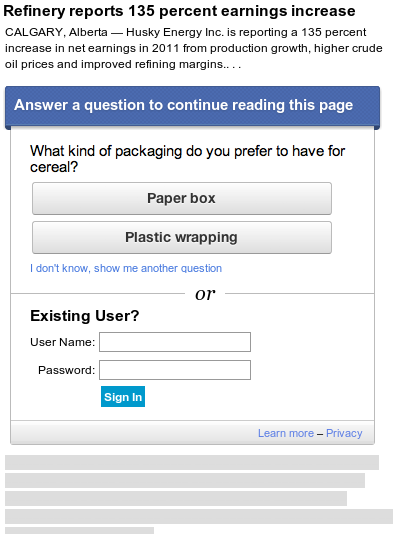
Now, you may see a new option: the ability to access some of this content by responding to microsurveys, without having to pull out your wallet or sign in. When a site has implemented this option, you’ll see a prompt that offers you a choice between answering a market research question or completing another action specified by the publisher (such as signing up for an account or purchasing access). All responses are completely anonymous -- they aren’t tied to your identity or later used to target ads. The prompts look like this:
Publishers get paid for hosting surveys. A number of publishers, such as the
The Texas Tribune
, the
Star Tribune
and
Adweek
have already started running these microsurveys on their sites.
So what’s the point of these questions? From international brands to local food trucks, every business owner wants to make important decisions with their customers’ feedback in mind. That’s why we’ve created
Google Consumer Surveys
, a new business-facing product that makes custom market research easy. It enables companies to ask questions (the ones you'll later see on your screen) and get back quantitative results quickly, accurately and cost-effectively. Companies have already been using it to research everything from online shopping behavior (Lucky Brand Jeans) to gluten-free baking mixes (King Arthur Flour), and to assess brand awareness (Timbuk2) and inform product development (479 Popcorn). Google shares the money these companies spend with our publisher partners.
The idea behind Google Consumer Surveys is to create a model that benefits everyone. You get to keep enjoying your favorite online content, publishers have an additional option for making money from that content, and businesses have a new way of finding out what their customers want.
If you’re a publisher interested in running microsurveys on your site,
let us know
.
Labels
announcements
30
currently in the news
13
features
43
Google News Blog
153
help for publishers
21
languages and editions
13
looking backward
7
Archive
2016
Sep
May
Apr
2015
Aug
2014
Aug
Feb
2013
Dec
Jun
Mar
2012
Dec
Oct
Sep
May
Mar
Jan
2011
Nov
Oct
Sep
Aug
Jul
Jun
May
Apr
Feb
2010
Nov
Oct
Sep
Aug
Jul
Jun
May
Apr
Feb
Jan
2009
Dec
Nov
Sep
Aug
Jul
Jun
May
Apr
Mar
Feb
Jan
2008
Nov
Oct
Sep
Aug
Jun
May
Apr
Mar
Feb
Jan
2007
Dec
Nov
Oct
Sep
Aug
Jul
Jun
Feed
Google
on
Follow @google
Follow
Give us feedback in our
Product Forums
.





 Follow